Green App Machine
Posts mit dem Label Boost werden angezeigt. Alle Posts anzeigen

Taking names: Facebook's newest ad unit could help retailers boost their email lists

Facebook’s product is important because email is the most cost-effective marketing channel that online retailers use.


Lead Photo

Facebook Inc.’s latest advertising product could help retailers add names to their email marketing lists.


The social network today rolled out lead ads, a new ad format that eliminates the need for shoppers to fill out forms, such as an email marketing signup.


“These days people expect to be able to do everything from their phones,” Facebook states  in a blog post. “Mobile phones are where people communicate and discover the things they like, but historically, it’s been difficult for people on mobile to signal to businesses that they want to learn more about their products or services.” Lead ads aim to address that challenge by giving shoppers a way to sign up to receive information—like marketing emails and special offers—from retailers and other businesses in two clicks.


Here’s how the ad works: When a consumer clicks on a lead ad, a form that’s automatically populated with the contact information he has shared with Facebook, such as his name and email address, pops up. The consumer can then either edit that information or click a Submit button.


The information shared in a lead ad can then be integrated in real time within retailers’ customer relationship management systems, assuming that they work with one of the six vendors that Facebook is working with—Driftrock, Marketo, Maropost, Oracle Marketing Cloud, Sailthru and Salesforce. 27 retailers in the 2015 Top 500 Guide use one of those vendors’ systems, according to Internet Retailer’s Top500Guide.com. Merchants who use another system can manually set up a link between their CRM system and Facebook through a software conduit known as an application programming interface, or API, or they can download lead information manually into a comma-separated values, or CSV, file.


Shoe manufacturer and retailer Stuart Weitzman LLC used lead ads to find shoppers who wanted to receive its marketing emails, which feature updates and an “inside look into the world of Stuart Weitzman.” The ads yielded a 52% more efficient cost per lead across domestic and international markets, says Susan Duffy, chief marketing officer for the retailer, which is No. 473 in the Internet Retailer 2015 Top 500 Guide.


Email is a particularly appealing marketing channel for online retailers because it is easy on marketers’ budgets. For instance, Forrester Research Inc.’s “The State of Retailing Online 2015: Marketing and Merchandising,” which is based on a survey of 224 North American retailers, found that merchants email’s average cost per order is $6, making it the least expensive channel among the 32 channels it examined. For the sake of comparison, the average cost per order for retargeting ads is $10, $11 for affiliates and $28 for social media ads. 


Taking names: Facebook"s newest ad unit could help retailers boost their email lists

How to Boost Email Marketing ROI? Put Your Customer Data to Work

Only 20 percent of marketers use behavioral triggers to accompany their email marketing strategies, according to Econsultancy. Past issues with implementation and the lack of comprehension of the outcomes email triggers can drive on behalf of the e-commerce company have led many email marketers to believe the many misconceptions about trigger emails.


With data come opportunities
The expectation of today’s marketers is to monitor the analytics of their campaigns to ensure they are providing a positive ROI as compared to their investment in a specific channel. The industry has reached an inflection point where marketers need to know how to take action on their data and understand the technologies available to help them better facilitate driving results from company data.


Referring to analytics is often the starting step to discovering value in your customer data for many marketers, whether it is through Google Analytics, Omniture, or an alternative tracking platform, and to begin getting into the performance of your various conversion funnels. Larger organizations may have business teams devoted to analyzing and segmenting this data.


A frequently overlooked source of vital data can be taken directly from your product catalogs. Both customer behaviors and changes to the product catalog will show trends around failed conversions, customer drop-off points or out-of-stock products. These are potential opportunities to reengage with your shoppers and help influence them to convert with automated emails.


For example, many e-commerce companies find data that suggests their shoppers start an order but do not complete their purchase. This shopping cart abandonment data can demonstrate a great amount of lost opportunity revenue. With some companies reporting that up to 74 percent of shopping carts are left abandoned, it is not an uncommon problem.


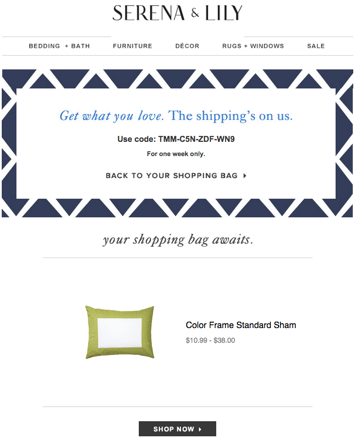
Through analyzing your conversion funnels and customer data, you can better distinguish where behavioral triggers can help to drive ROI. For example, Serena & Lily aimed to tackle lost opportunities that they found in their data by triggering the following email when a shopper abandons her order.


Description: erena & Lily seeks to drive revenue by targeting shoppers who failed to complete their transaction.


Serena & Lily attempts to increase revenue through targeting shoppers who failed to complete their transaction.


In addition to a reminder, Serena & Lily also offers free shipping to better incentivize their shoppers to return and make a specific purchase. While offering incentives can improve the effectiveness of a specific triggered email, it is recommended you test a variety of these tactics to determine which fit best with your marketing and revenue goals.


Triggered email implementation = increased ROI
While improving metrics for open, click through, and conversion rates for automated emails is important, perhaps what is most notable is that automated emails generated nearly three times more revenue than their manually delivered counterparts.


Automated emails are often more effective because your brand can target your audience based on their behavioral data, meaning that you can send more relevant and personalized content to your shoppers while your company is already top of mind.


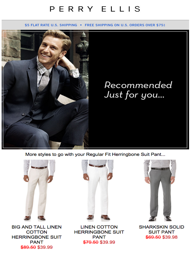
For example, let’s say a shopper recently purchased a pair of Herringbone suit pants from Perry Ellis. By sending an automated follow-up email, Perry Ellis now possesses the opportunity to upsell and create more revenue by catering this email content to the details that the shopper provided at checkout.


Description: erry Ellis appeals to their shopper⤙s interests by promoting related products with partial discounts.


Perry Ellis appeals to its shoppers’ interests by promoting related products with partial discounts.


The retailer also takes advantage of customer data to better comprehend what products are related or frequently purchased together and can use this to provide more interesting content to its shoppers. The more personalized the email, the more likely it will resonate with the shopper and create positive actions.


It’s also vital to understand the difference between trigger emails that drive engagement and immediate revenue for your business. For example, many post purchase emails are typically more focused on engagement, satisfaction and driving revenue in the long-term like a survey or content centered around better using a product recently purchased, than they are on generating immediate revenue from an existing customer like a related products trigger.


The difference in whether a trigger drives action or revenue is completely dependent on the company, the typical product order value, and the objective they are trying to achieve. Triggers are flexible when you have a system that allows you to rapidly adjust dependent on the feedback you’re receiving from your customer and product catalog data.


To best drive revenue for you company, prioritize the customer behaviors that are stopping conversions and develop personalized triggered emails that help escort your shoppers through your sales funnels. Evaluate the interests and needs of your shoppers when designing these emails to better increase opens, click through rates and the ROI of your email marketing campaigns.


Ryan Luckin is head of marketing and communications for Bluecore, a marketing automation solutions provider.


How to Boost Email Marketing ROI? Put Your Customer Data to Work

How Spredfast helps boost your social media marketing efforts

spredfast


Spredfast launches Intelligence tool


Social media has become an integral part of our daily lives and learning to market yourself and your brand effectively across these platforms has become more important than ever before. There are a plethora of analytical tools available, but learning to use them can be just as complicated as learning to market yourself.


bar
Austin-based brand, Spredfast, a Facebook Marketing Partner, just announced the launch of Intelligence. Intelligence is a new tool aimed at providing insight into marketing strategies by measuring performance and providing competitive analysis, making it easier to uncover the context and relevancy of your next social media marketing campaign.


How Intelligence unveils trends in real time


Intelligence indexes the overwhelming stream of social media data from Twitter, Tumblr, and Facebook and provides real time trends. This enables you to discover and predict trends, as well as, helping you find the optimal times to quickly and effectively engage with your audience.


According to Spredfast’s case study, Hyatt used the platform to enable the hotel concierge to respond to growing demand on Twitter more effectively. The average response time from brands on social media is more than eleven hours, but the best in class brands are aiming to respond in thirty minutes (according to this analysis). Hyatt set their sights even higher, aiming to respond to Twitter followers in ten minutes or less.


According to the Spredfast case study, Hyatt reduced their response time by nearly 50 percent, as well as, increasing the total number of answers to social media queries, and boosted productivity related to responding to customers on social media by 180 percent. Intelligence enables companies to identify influencers and see who is sharing links, or driving the current trend on brand or campaign hashtags.


How Intelligence is more than just a listening tool


Here is how Intelligence is different: it goes beyond being a “listening” tool, it is an active searching tool as well. You can receive alerts about the trending topics mentioned above, but you can also scan conversations, influencers, images, and videos in real time. You can also look retroactively (up to thirteen months) by using “social recall.”


This tool allows you to track specific topics and engagement over a longer period of time. Users receive alerts about trending topics, and can now scan conversations, influencers, images and videos in real time (or historically), using a “social recall” interface which can be set to track specific topics and engagement by specific audiences (read: demographics).


Basically, Intelligence can tell you what happened, what’s happening, and what’s going to happen in the future, on one simplified platform. Perfect for tracking trends, influencers, and brands without the hassle of searching them out on your own.


#SpredfastIntelligence


How Spredfast helps boost your social media marketing efforts

Survey: Nearly 60% of Marketers Plan to Boost Influencer Marketing Budgets

TomosonInfluencerMarketingBudgetChartInfluencer marketing is becoming an effective way for brands to generate big returns on social. As new influencers emerge on different social networks, businesses are looking to connect with those influencial people and their followers. Influencer marketing platform Tomoson recently polled marketers to get a sense of the current state of the market.


Tomoson surveyed 125 marketers to get their opinions on how much revenue influencer marketing can generate, along with other metrics. 59 percent of those marketers believe in influencer marketing so firmly that they plan to increase their ad budgets for it within the next 12 months. 11 percent plan to maintain their present budget, 20 percent are unsure and only 10 percent plan to decrease their spending.


In terms of growth, 22 percent of marketers rated influencer marketing as the fastest-growing online customer-acquisition method. Organic search was ranked second at 17 percent, and email came in at 15 percent. Among the marketers surveyed, only 5 percent believed affiliate marketing was a growing method for customer acquisition.


The survey revealed that influencer marketing provides great returns for most of the businesses that use it. On average, businesses are making $6.50 for every $1 spent. 70 percent of businesses are seeing a return of $2 per $1 spent, and the top 13 percent of marketers are gaining $20 per $1 spent. That said, 30 percent of marketers are losing money, or just breaking even.


When asked which metrics are most important, marketers were heavily focused on revenue. 56 percent believe that the greatest measure of success was the amount of revenue generated. 14 percent considered social shares to be most important, while 9 percent valued click-through rates and 5 percent were happy with the earned-media value the marketing generated.


To see which platforms are most important to influencer marketing, or to see which channels are most cost effective, view the poll data here.


Survey: Nearly 60% of Marketers Plan to Boost Influencer Marketing Budgets

Marketing Ideas for Valentine's Day That Will Boost Your ROI

For any business, regardless of industry, integrating themes from relevant holidays into your marketing efforts provides a unique opportunity to reach your target audience in a creative way – ideally generating sales as a result. With Valentine’s Day rapidly approaching, you can really stand out among the competition and engage with your audience differently than other businesses and their normal, day-to-day marketing strategy. Even if you don’t sell jewelry or flowers, you can still use effective marketing tactics to leverage success from this widely celebrated holiday.


With any holiday-related campaign, there are three core ways that you can approach your audience – social media, email marketing, or a microsite designed for your campaign. All three campaign channels should have consistent messaging but be specific to the nature of each, and can be used in tandem with one another or on their own to get your business measurable results.


Social Media Campaigns
An excellent social presence is imperative to the growth of your brand. With more and more users active across all platforms of social media, any holiday provides you with another chance to provide incredible value to your audience, in a creative, fun way. As you begin planning your social campaign, the overarching focus should be to optimize all of your social media profiles for Valentine’s Day in whatever ways you can.
Imagery is one of the most important aspects to get right–and is also one of the most effective ways to optimize your profiles for Valentine’s Day. For example, Facebook is an obvious choice for a lot of brands when it comes to a social campaign. You can change your cover photo to a themed image that also reflects your year-long branding, and use image-based posts to engage users. Posts on Facebook cannot be more than 20% text, which makes sense. Visuals should be the main component of your post.


The messaging on your social platforms must have strong calls-to-action, or your campaign won’t be effective. That being said, it should be done tastefully. Whatever action you want the user to take, it must be clear and identifiable, but not cost your brand’s integrity in the process. Typically, in social campaigns you want users to share your posts so that it reaches a wider audience, however users won’t share content that they don’t enjoy. You need to think about what would interest your target audience, and give them good reason to share content. For Valentine’s Day, a prize giveaway is a relatively simply way to encourage social interaction if you’re a B2C. If you’re a B2B you may want to offer exclusive discount pricing for the holiday and promote it through social.


It’s proven that content most frequently shared utilizes humor or statistics to engage users. Think about that concept and find a way that you can relate it back to your brand while still maintaining the Valentine’s Day spirit. It could be a funny joke about the holiday, or even a statistic about how many people really don’t enjoy the holiday. If you try to get in the mindset of your audience, you’ll have a better understanding as to what kind of content they would want to see on their news feed, and in return what type of content they would most likely share.


Email Marketing Campaigns
Email marketing campaigns are a proven way to foster engagement with your audience because of the ability to creatively target users in their inbox – according to eMarketer, 36% of US internet users check their email at least a few times a day. This kind of campaign also provides concrete insights as to what was effective or ineffective with your audience because you can easily monitor open rates, click through rates, and how they behave once they are onsite. Based on findings at the end of one campaign, you may decide to change a certain layout, design element or messaging.


For a Valentine’s Day email, your general layout should be original with some sort of interactive elements built in. Whether you want to embed games, animations, or personalize the message for your users, you need to have something creative that will spark interest. For our Valentine’s Day campaign, we’re using candy hearts and Valentine’s Day branding while still including our standard logo and navigation elements to catch attention while still creating something unique.


2015-02-05-valentinesday.png


You also need to think about where your call-to-action button will fit in with your email layout–it is undoubtedly one of the most important aspects of an email campaign. The CTAs should be bold and stand out in the email so that users can find the buttons without hesitation. Additionally, they should be visually attractive while still fitting in with the overall branding and theme of your email. You don’t want a CTA that is the complete opposite of typical design elements.


The timing of your emails is critical to the success of the campaign. You should always consider when your typical distribution is for your regularly scheduled emails so that you aren’t bombarding users from the same list with a Valentine’s Day email a few minutes after they received another email about a new product. Different from the typical holiday season in December, you don’t have to send out emails months before Valentine’s Day. You can send it out a few days before the holiday, but not so far in advance that it loses its value. If you are a B2C, encourage users to make a purchase with free shipping, and display delivery deadlines for when orders should be placed to ensure arrival by Valentine’s Day. If you are B2B and using your campaign to continue fostering relationships with clients, the best option is to send out the email that day.


Microsite Campaigns
To further reinforce the campaign message, developing a separate landing page or microsite to take users to is an effective approach at boosting engagement and business growth. A separate microsite gives you the freedom to really showcase some creativity and craft content that is fitting with your brand, but also specifically geared towards Valentine’s Day.


Your landing page for a particular campaign should be connected to your other campaign channels. After seeing a post on social, or in their inbox, users should be able to seamlessly switch over to the landing page by clicking a button. Having all aspects of the campaign mirrored off one another, and integrated will help to strengthen your overall message as users switch from one platform to the next. Your social media campaign and email marketing campaign should be responsible for capturing the interest of your users, and then directing them to your microsite for additional value that you have to offer.


When users visit your micro-site or landing page, it should have the same messaging that they initially saw, providing confidence that users are on the correct page, and can tell there is a noticeable, consistent brand presence. This separate site is your opportunity to really amplify any design elements that you want to be related to Valentine’s Day. Whatever your products or services may be, they need to have a special twist for the holiday and be really “dressed up.”


In terms of SEO value, a holiday page can offer a lot for your brand. Timely events always draw impressive amounts of organic traffic because the holiday is on people’s minds and they are actively searching for it. Long term, year after year, if you have a good campaign, when the holiday rolls around again, it will continue to rank well when people search for the subject, and the page will help generate leads as long as you consistently are updating it.


Creating a Cohesive Valentine’s Day Campaign
Overall the most important concept to understand is that using a combination of all three approaches creatively, and planning in advance is going to contribute heavily to your success. Building a consistent presence through all of your platforms will further your campaign’s effectiveness and will build credibility for your brand in the eyes of your target audience.


Additionally, using an analytics program to track and monitor where traffic is coming from as a result of your campaign efforts is critical to measuring your success. You want to be able to determine where your traffic came from–otherwise you won’t be able to gauge what you should enhance for future campaigns. You can easily define which words or images were most effective and provided the best conversion rates, and use that as a guiding factor will help you build future campaigns.


Marketing Ideas for Valentine"s Day That Will Boost Your ROI