Green App Machine
Posts mit dem Label Campaigns werden angezeigt. Alle Posts anzeigen

5 Ways to Integrate Twitter Into Your Cross-Channel Marketing Campaigns

twitter cross channel marketing

Your customers aren’t only on Twitter. They’re on Facebook in the evenings, watching TV while they get ready for work, reading the news on the subway and browsing forums in bed. In short: they can be anywhere, at any time. Is your message reaching them?


Twitter can be a powerful tool on its own to drive brand awareness, create a stellar reputation and even generate leads. However, it is also a powerful tool when used in combination with other channels, to reach your audience on their terms.


Here are 5 ideas for integrating Twitter into a cross-channel marketing campaign:


1. Learn about your audience


One aspect of Twitter that many marketers overlook is its ability to provide deep audience insights, that can fuel not only Twitter-based campaigns, but all aspects of a marketing strategy.


Because Twitter is an open, real-time network, you can tap into the behaviors, demographics, interests and more of your audience (or any audience you want to focus in on). Using third-party tools to gather and analyze this social data, you can develop a more targeted marketing campaign, from the landing pages you create to the magazine ad copy you write.


2. Connect with their favorite TV shows


Many TV watchers – especially those who just can’t get enough live and reality TV – will use their “second screen” (typically a tablet, their smartphone or a laptop) while watching their favorite shows. So why not use this knowledge to your advantage, and run a Twitter campaign?


If you know what TV shows or sports games your audience loves, try searching for their hashtags on Twitter. Then, while the show is broadcasting, you can tweet alongside your audience. You have the opportunity to tweet a related contest, show that you share the same interests as your audience, or just monitor how they engage with this TV show to inform future campaigns.


3. Run a contest


A Twitter contest is one thing, but a “social media contest” is a different beast altogether. Running a contest that spans Twitter, Facebook, Instagram and other networks isn’t necessarily easy, but the results are often worth it.


Your audience probably has multiple touchpoints with your brand, in addition to Twitter. So if you are running a contest of any type, promote it across all of your marketing channels – social media as well as your blog, website and wherever else it makes sense. This will ensure that your audience sees the contest wherever they are online.


And if you’re able to collect responses from your audience across multiple channels, you’re likely to see better participation and positive word-of-mouth.


4. Promote a live event


Whether you’re hosting a live event or just attending, using Twitter while it’s happening is a great way to engage with your audience. However, you can also bake Twitter into a multi-channel live event strategy – tweeting behind-the-scenes images while you blog about key takeaways and post Instagram pictures of visitors to your booth, for instance.


5. Target better search and display ads


If part of your marketing strategy involves using ads to reach your audience, Twitter can help with that, too. You can learn about the type of content that resonates with your audience on Twitter by examining your past tweets on Twitter Analytics. From there, it’s simply a matter of mirroring the tone of voice, images and content in your search and display ads.


(Marketing team image via Shutterstock)


5 Ways to Integrate Twitter Into Your Cross-Channel Marketing Campaigns

IBM and Facebook Join Forces to Augment Personalized Marketing Campaigns

August 21, 2015


In case you haven’t noticed, marketing and ad campaigns on the Web are continuing to become more and more personalized, thanks to advances in targeting technology and an ever-growing mass of consumer data. One of the pioneers in this area is of course Facebook, which has access to an unfathomably large and growing user base willingly supplying a wealth of personal data that serves as the basis for its Custom Audience insights for marketers.


Technology giant IBM now plans to expand its own marketing tools and services with the recent signing of a deal with Facebook. Under the agreement the two companies will collaborate on merging their data to form a more comprehensive and effective version of the IBM Marketing Cloud campaign management platform. The goal is to address the three components of a successful campaign that must come together in order to attract the most business: ads should be personalized and friendly, only delivered to users it will be relevant for and delivered at an opportune moment.


The Marketing Cloud platform relies heavily on retail data such as purchase and item viewing history. By correlating this data with users’ Facebook data, marketers have access to a much broader range of information for personalizing ad campaigns and meeting the aforementioned criteria. As a result ads can be better targeted to specific market segments and tie in seamlessly with activity on retail sites.


The two companies will work together further in the brand new IBM Commerce THINKLab, of which Facebook is the first member. THINKLab is a research and collaboration effort dedicated to working directly with brands to develop beneficial new technologies and techniques for creating customized customer experiences.


This announcement reflects IBM’s interest in rethinking its business model and expanding support for newer technologies and trends in the industry. The company also signed a deal with social media service Twitter to incorporate its immense store of data into Watson, IBM’s cutting edge artificial intelligence platform. Now the company can focus on helping marketers develop successful ad campaigns that are more personal than ever without coming off as creepy to unsuspecting social media users.


IBM and Facebook Join Forces to Augment Personalized Marketing Campaigns

How to Use Email Campaigns and Facebook Ads to Achieve Personalization in Marketing

2015-08-19-1440000992-6235425-FanBi.png


Author Fan Bi is the CEO of Blank Label, an award-winning custom menswear brand. Since founding in 2010, Blank Label has shipped over 100,000 custom garments to customers all over the world, and has stores in Boston and Washington D.C.


When a new company attacks a market, they often take a niche approach. Call it thin edge of the wedge, or establishing a “beachhead,” the point is that they try to speak to an audience that is currently underserved by existing players with a message or feature that resonates. The logic is that every group, down to the individual person, has slightly different preferences: that’s why there are so many options for cereal at your grocery store.


With digital marketing, you’re able to take this personalization to the extreme. In fact, according a recent Forrester survey, 63 percent of marketers rated personalization as “extremely important” to their long-term goals. What’s more, an Adobe survey of marketers tapped personalization as the most important feature, above big data and social.


The two easiest ways to bring personalization into your marketing program are through email campaigns and Facebook ads. Here’s how you can implement these tactics into your customer strategy.


Email Campaigns


If you do any kind of email marketing, you should almost certainly be using an ESP (email service provider) that integrates with your database of customers and allows you to sort based on different attributes. We use the ESP Klaviyo, though I’ve also heard good things about Customer.io and Vero. When someone places an order with our company, Blank Label, we send basic purchase information to Klaviyo, including customer name, product, price and time of purchase. From there, we can create different lists, such as one for customers who have only purchased dress shirts, and another for people who haven’t purchased in the last 12 months. The purpose of this list segmentation is to be able to send more tailored messages.


As an example, for our customers who’ve only purchased dress shirts, they’ll be the first we email when we get new dress shirts. Plus, we can send them specific emails to cross-sell them into other products. For our customers who haven’t purchased in 12 months, we can send something like “Hey Jim, we noticed you hadn’t visited us in a while, we just wanted to send you a courtesy email to make sure your garments are treating you well.”


These new personalized ESPs also can take website data, so that when the customers who haven’t purchased in 12 months visit the site, log in and don’t make a purchase on that visit, you can send them a personalized email, such as: “Jim, glad to see you back at Blank Label, we just wanted to make sure we could be helpful and if you had any questions about the new website changes.”


Facebook Advertising


Now that you have different lists created in your ESP based on the different attributes you want to target and send personalized messages to, you can export the email addresses in these lists and upload them to Facebook’s Ad Manager. If you navigate to the Audiences tab and create a new group, e.g. “Inactive 12-month customers,” Facebook will match those emails with profiles it has in its user database. You won’t be able to reach everyone on Facebook from your ESP list, but there should be a high percentage of coverage.


Using a similar message to your email campaigns, you can now send tailored messages using Facebook’s banner ad format to these different groups. Some of our more successful Facebook campaigns using this tactic are targeting our highest spend customers and reminding them about our referral program, as well as notifying people geographically close to one of our stores about upcoming events or new store openings. If you have a segment list of a few thousand people, you’ll be able to reach them once a week for as low as $10 a day.


When determining how to best distinguish your brand from the competition, consider using personalized email campaigns as well as Facebook banner ads to underscore your understanding of each customer — at the individual level.


How to Use Email Campaigns and Facebook Ads to Achieve Personalization in Marketing

Implementing JSON-LD Structured Data in your E-Mail Marketing Campaigns

E-mail, JSON-LD, and Structured Data


Implementing schemas on websites are a great way of enriching structured data, and has been for the past few years. Schema by no means is an easy task to implement especially if you have no web development background. Recently Google has announced another format of implementing schema utilizing the javascript format “JSON-LD” to make implementing a bit easier. Many web marketers have had success implementing JSON-LD within websites. What is even more impressive are marketers are pushing the envelope, utilizing the new schema format in advanced ways to provide rich insights. We have seen semantic data that can be dynamically pushed from Google Tag Manager to a website, thus sending the data to Google Analytics for measurement. However what is not as well know is implementing JSON-LD within your e-mail marketing campaigns to provide a better user experience and rich data.


Unlocking the Full Potential of E-mails


There is a new generation of digital marketers that feel e-mail marketing is old school. However, e-mail marketing is still one of the preferred digital marketing techniques used to date. Email is an important part of how we get things done.


RSVP Action


We check our e-mails hundreds of times a week. We plan trips, organize events, check-in with flights and much more. For a while Google has made it apparent that they are moving towards enriching all data as much as possible. Why not emails right? Adding schema.org markup to your e-mails will create a better user experience by adding quick actions, check-in times, reservation actions and more. Google’s Inbox, Search, Calendar, and Google Now all use structured data. You can now start enriching your data as well!


Apps Script


To start it is best to test your schema e-mail markup by sending an e-mail to yourself. First visit scripts.google.com. You will be redirected to the information page if it is your first time. Begin by clicking on Start Scripting which will bring you to the script editor. From there create a script for Blank Project.


Recommended for YouWebcast: Answers to the Top 10 Email Marketing Questions


Next you will want to replace the code that is in “Code.gs” with the following:


Email Markup


Next you will want to select File > New > Html file. The important part here is to name the file “mail_template” which matches the parameter in the javascript shown in the picture above. Replace the content of the HTML file with the following, however just remember to change your own “URL” and “target” to whatever you would like for test purposes.


Email Markup2


Testing the Structured Data


Remember in math class, when the professor always talked about “checking your work”? Well that is a rule I still commit to, day in and day out when it comes to script. JSON-LD, scripts, and coding can work well when it wants to. However all it takes is for one misplaced comma and the script will not fire correctly. Therefore we need to check our work. To test we need to save the project. Next select the tab “Code.gs” which is on the left side of the script page. Here you want to make sure the function “testSchemas” is selected in the “Select Function” dropdown menu.


Email Markup3


After you run the script you’ll be asked to grant authorization. After that you will need to re-run the script. At this point you should check your inbox. You should see an e-mail from yourself with a “Go-to Action” button like I have shown below!


Email Markup4


Registering with all mighty Google


So now that you have that down, its time to register with Google which is a pretty simple process. Currently Google lets you send e-mails with scripts embed to yourself strictly for testing purposes. However, if you would like to start using this for your users in your e-mail marketing campaigns you will need to register with Google and follow their steps. Its pretty easy. Head on over to developers.google.com to set up the registration process!


Whether you are email marketing for a large business that needs to send out reservation e-mail markup to your next event; or an individual on a job search that would like to increase his/her CTR to their resume in emails. Everyone can benefit from JSON-LD structured e-mail markup.


Implementing JSON-LD Structured Data in your E-Mail Marketing Campaigns

Top 5 Reasons to Use Google's New Call Only Campaigns

Google has proven once again that it is the king of online marketing with paid search marketing campaigns. Their latest innovation is called “Call-Only Campaigns”, a new type of ad which focus solely on mobile users. Call-only campaigns help you focus on your mobile traffic, where the conversion event is more than often a call. This new type of search campaign works amazingly well for advertisers, publishers and corporations that benefit more from a phone call than from a click.


Image Credit: Jan Vašek


For instance, if you own a roofing company or a hotel, Google’s call only campaigns could prove ten times more useful than a standard PPC campaign, because the customer will contact you directly instead of accessing your website first. If you have not made up your mind yet, here are the 5 big reasons to include call-only campaigns in your marketing strategy.


1. Extremely effective


Mobile users have the tendency to click on the phone number first and only after that on business description and website. This makes call-only ads the most effective PPC ads.


2. Proven to be genuine


According to a study conducted in the United States by a group of marketers led by scientists from the University of Virginia, over 70% of mobile users call a company directly from search results, while around 29% call it after finding a phone number on the website.


3. User-Friendly


This method of promoting your company is extremely user friendly. Users can easily find your number in search results, click it and call you directly. There is no need to copy-paste the number or memorize it (this is the case of websites and blogs).


4. Lower bids


Call-only ads are more affordable compared to other PPC ads for desktop Internet users.


5. Good value for the money


Most people who call a business using call-only ads are normally more serious, with a higher intent to become a customer.


For a little more info about call-only ad’s check out this infographic.


Top 5 Reasons to Use Google"s New Call Only Campaigns

4 rules to follow for successful email campaigns


Kristina: How can a strong email data strategy help brands better profile customers and behaviors?


Aaron Beach, Data Scientist, SendGrid: Current email providers like Yahoo and Google are using algorithms to track email engagement and determine if your email marketing campaign will be delivered to the inbox or the spam folder. Instead of fixing the problem by using data to enhance and add value to their email marketing campaigns, many marketers are trying to find loop holes in the algorithms which allow them to fake a good email so it gets delivered. However, just because an email was delivered doesn’t mean that it was opened or clicked on.


Kristina: Is the worth of email list members skewed?


Aaron: As shared in the [Winterberry Group] report, more than $9 billion of the $11.5 billion will go into perfecting mailing lists because marketers realize the importance of good email sending. There has been an incorrect assumption for some time now that the most engaged recipients are just 2 to 3 times more engaged than less engaged recipients. This assumption directly leads to bad sending strategies. The truth is, the top 10 percent of engaged recipients are 100 times more likely to engage in your email marketing campaign. By recognizing this, marketers will see that sending strategies can’t be one-size-fits-all. For example, if you’re a daily deal sender and a specific customer on your email recipient list doesn’t engage with your email within 60 days, then we recommend you remove them from your email lists to prevent being marked as spam. To do this automatically, you need to build a model to determine engagement frequency, which, is one way to bake a data-driven culture into a marketing organization.


Kristina: What are the four rules marketers need to abide by in email?


Aaron: Maximize the subject line: Subject lines of six to 10 words are most effective, yielding open rates of 21 percent, while subject lines of 11 to 15 words secured only 14 percent open rates.
Don’t overuse images: If an image is used in an email marketing campaign, make sure it’s sensibly balanced with at least two lines of text per picture, to reduce the risk of emails being classified as spam.
Focus on formatting: Today’s email recipients access their accounts via a range of devices, so it’s vital to cater to smartphones, tablets and desktops to avoid being directed to spam. Include a plain text version in HTML email and make use of responsive design templates.
Get personal: Personalizing messages can see an uplift of 20 percent to email open rates. Why go through the hard work of asking for a first and last name during the sign-up process if you don’t use them?


Image via Shutterstock


Tags: SendGrid, email marketing, email marketing tips, rules of email


4 rules to follow for successful email campaigns

YC-Backed Answerbook Helps Retailers Automate Personalized Email Campaigns


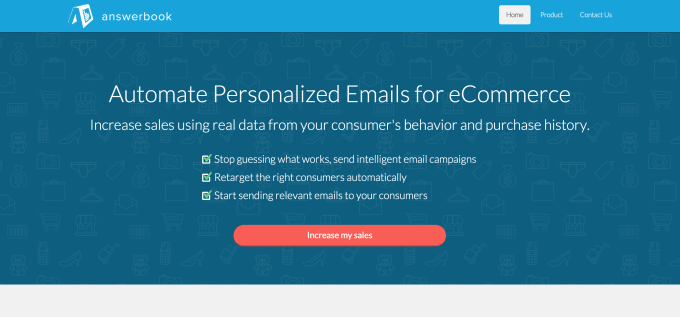
A team of e-commerce vets is today launching a new service aimed at online retailers called Answerbook which allows companies to better target shoppers with highly personalized emails based on those customers’ website and email interactions as well as their purchase history. The solution today is largely aimed at smaller retailers, like those hosting their sites on e-commerce platforms like Shopify, where they have somewhere between half a million to a million in sales.


However, the company is already talking to larger businesses in an effort to develop an enterprise tier to its service, we’re told.


Answerbook was founded last year by Chris Nguyen and Lee Liu, both of whom have backgrounds in e-commerce and using data for targeting purposes. The two had previously built and sold their recruiting site JobLoft to onTargetjobs in 2007, and then sold dating site Cupid.com to EasyDate. They also founded a social commerce site called TeamSave in 2010.


While in all their prior efforts, the founders had learned the value of leveraging data in order to attract and re-engage users, it was with TeamSave that they began building an internal personalized marketing solution, using things like website preferences, clicks and purchase history to better reach their customers.


answerbook


Explains Nguyen, smaller companies don’t have the tools to do advanced targeting the way that the bigger guys, like Amazon, eBay and Walmart do. And the solutions for email personalization that are out there today often only look at customer purchase history, not other factors.


“We started talking to e-commerce companies, and they said, ‘we have this problem – we’re sending blast emails everyday but we don’t know how to personalize this information,’” says Nguyen. The companies have internal teams who could pull data to personalize their emails, but by the time they did, it would be too late for that data to still be actionable. “Can you help us automate that?,” these businesses said.


“I love the fact that companies like Shopify allow you to make a fast and efficient online store in days, but they lack the resources to truly understand the marketing aspects,” Nguyen adds, explaining the hole in the market he hopes Answerbook can fill.


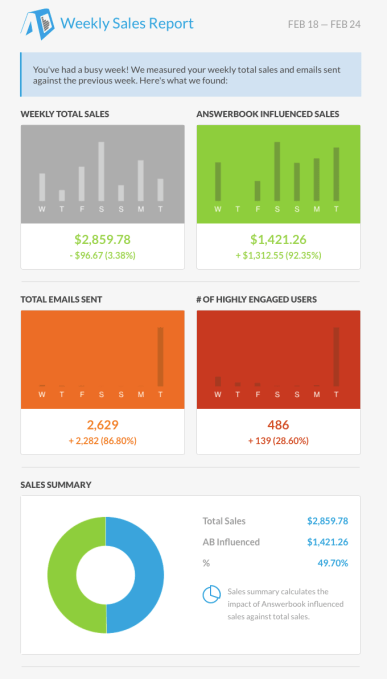
To use Answerbook, retailers place a single line of JavaScript code on their website, similar to setting up something like Google Analytics. Afterwards, they’re then able to track things like what pages and products a customer is viewing, what they’re placing in their cart, their purchase history and more. Combined with email interaction behavior, this data can then be used to create a series of personalized emails for each customer.


Screen Shot 2015-02-25 at 1.14.05 PM


Screen Shot 2015-02-25 at 1.16.17 PM


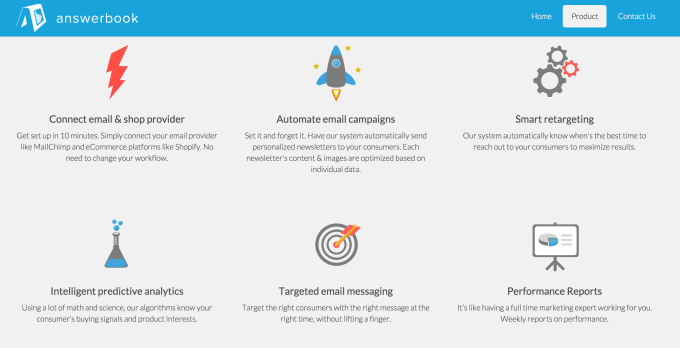
Included in Answerbook’s service are a half-dozen “triggers” a retailer can kick off, which help them to configure emails related to things like price drops, cart abandonment, items that have returned to stock, website abandonment, or they can send emails that simply recommend products or showcase what’s new and trending this week on the retailer’s site. Businesses can also choose to create their own custom triggers, or combine the ones provided to more narrowly target their customers. And Answerbook today works with other email services the company may already be using, like MailChimp, for example.


The company has been in private testing with a small handful of retailers ahead of its public launch. One online phone case company saw a 40% lift in sales after setting up Answerbook to email reminders to customers which included a 15% promotion to complete their orders. However, because of each business’s potential needs, and because of the newness of the service itself, a sales lift of that much may not be typical. Nguyen admits that the lift can range anywhere form 15% to 40%, depending on the given situation.


Answerbook is currently priced beginning at $50 per month for 500 customers analyzed and then increases in tiers that go from $150/month to $199/month, with an enterprise option in the works.


The company has also raised $700,000 in seed funding from Y Combinator, Kima Ventures, Tamares (a Palantir backer), and a group of San Francisco Bay area angels.


Longer-term, Nguyen says that Answerbook’s goal is to do more than personalize emails, but to personalize the targeted messages customers receive elsewhere, too. In the future, the service will include support for mobile commerce as well, allowing retailers to personalize their in-app push notifications and even SMS texts.


Featured Image: Shutterstock


YC-Backed Answerbook Helps Retailers Automate Personalized Email Campaigns

Helix House Reports Newly Implemented Unique Online Advertising Campaigns For Clients


Helix House, and Internet advertising agency with a growing presence in the industry reports newly implemented unique online advertising campaigns for clients.


(PRWEB) December 31, 2014


Helix House, and Internet advertising agency with a growing presence in the industry reports newly implemented unique online advertising campaigns for clients. One of the best ways for clients of Internet advertising agencies to enjoy better online exposure and visibility is to work with an Internet marketing firm that offers unique online advertising campaigns. Helix House is a trusted name in the industry that consistently exceeds client’s expectations when it comes to providing improved online visibility and Internet exposure. The company offers a wide variety of advantages not available with other Internet marketing firms. For example, clients can expect a dedicated account specialist to handle their campaign directly. This ensures greater accountability when it comes to tracking the progress and success of any Internet marketing or advertising campaign.


In addition, Helix House offers a wide variety of value added services such as bundled service and discounted Internet marketing and advertising. Offering exclusive search engine optimization and social media marketing strategies, the company delivers real and measurable results when it comes to any campaign. Businesses large and small enjoy impressive results when they choose to work with an experienced Internet marketing firm that strives to deliver the best in customer service. Helix House makes available a wide variety of Internet marketing services such as website development, text message marketing and email marketing as well as comprehensive pay per click campaigns that are intended to achieve excellent results for clients. Few other Internet marketing firms in the industry can compare with regard to return on investment for advertising and marketing dollars.


Helix House also affords potential clients the opportunity to talk with existing clients of the firm as a way to further understand the effectiveness of the Internet marketing advertising campaigns offered. Helix House has a constant rotating list of clients that have made themselves available to talk the perspective clients. Those wishing to achieve first page placement online in terms of competitive keywords and key phrases can hear first-hand stories of the successes that other companies have enjoyed when working with Helix House. Most importantly, this trusted and respected name in Internet marketing offers clients the added advantage of powerful tools such as heat maps and call tracking. These effective tools help businesses better understand the progression of a particular advertising or marketing campaign.


Helix House is a company that has stood the test of time when it comes to delivering proven results for Internet marketing and advertising efforts. As one of the top Internet marketing and advertising agencies in the industry, Helix House prides itself on staying abreast of the latest advances in changes throughout the industry. This helps to ensure that clients enjoy the greatest success and greatest return on investment when wishing to achieve greater online exposure. Saving clients money while achieving remarkable results is what this Internet marketing firm has been doing consistently year after year. This recent announcement with regard to newly implemented unique online advertising campaigns for clients is one more way that Helix House delivers results for clients.


Helix House is a highly innovative forward-looking Internet marketing agency located in sunny Arizona and beautiful New Mexico. The company has consistently exceeded industry expectations to routinely rank highest among some the best Internet marketing companies in the country. Recognized as an industry leader, this Internet marketing firm has helped hundreds of businesses across the country to gain better online ranking, online exposure and overall recognition. Helix House outpaces the competition year after year by leveraging the latest Internet technology, ideas and concepts to deliver extraordinary results for businesses large and small.


For the original version on PRWeb visit: http://www.prweb.com/releases/2015/01/prweb12420545.htm


Helix House Reports Newly Implemented Unique Online Advertising Campaigns For Clients