Green App Machine
Posts mit dem Label Retailers werden angezeigt. Alle Posts anzeigen

Taking names: Facebook's newest ad unit could help retailers boost their email lists

Facebook’s product is important because email is the most cost-effective marketing channel that online retailers use.


Lead Photo

Facebook Inc.’s latest advertising product could help retailers add names to their email marketing lists.


The social network today rolled out lead ads, a new ad format that eliminates the need for shoppers to fill out forms, such as an email marketing signup.


“These days people expect to be able to do everything from their phones,” Facebook states  in a blog post. “Mobile phones are where people communicate and discover the things they like, but historically, it’s been difficult for people on mobile to signal to businesses that they want to learn more about their products or services.” Lead ads aim to address that challenge by giving shoppers a way to sign up to receive information—like marketing emails and special offers—from retailers and other businesses in two clicks.


Here’s how the ad works: When a consumer clicks on a lead ad, a form that’s automatically populated with the contact information he has shared with Facebook, such as his name and email address, pops up. The consumer can then either edit that information or click a Submit button.


The information shared in a lead ad can then be integrated in real time within retailers’ customer relationship management systems, assuming that they work with one of the six vendors that Facebook is working with—Driftrock, Marketo, Maropost, Oracle Marketing Cloud, Sailthru and Salesforce. 27 retailers in the 2015 Top 500 Guide use one of those vendors’ systems, according to Internet Retailer’s Top500Guide.com. Merchants who use another system can manually set up a link between their CRM system and Facebook through a software conduit known as an application programming interface, or API, or they can download lead information manually into a comma-separated values, or CSV, file.


Shoe manufacturer and retailer Stuart Weitzman LLC used lead ads to find shoppers who wanted to receive its marketing emails, which feature updates and an “inside look into the world of Stuart Weitzman.” The ads yielded a 52% more efficient cost per lead across domestic and international markets, says Susan Duffy, chief marketing officer for the retailer, which is No. 473 in the Internet Retailer 2015 Top 500 Guide.


Email is a particularly appealing marketing channel for online retailers because it is easy on marketers’ budgets. For instance, Forrester Research Inc.’s “The State of Retailing Online 2015: Marketing and Merchandising,” which is based on a survey of 224 North American retailers, found that merchants email’s average cost per order is $6, making it the least expensive channel among the 32 channels it examined. For the sake of comparison, the average cost per order for retargeting ads is $10, $11 for affiliates and $28 for social media ads. 


Taking names: Facebook"s newest ad unit could help retailers boost their email lists

Online Shopping Facts All Retailers Should Know Revealed in TrueShip's Newest Report

SCOTTSDALE, AZ, Oct 09, 2015 (Marketwired via COMTEX) — TrueShip (http://www.trueship.com) — the leading provider of ecommerce shipping software (ReadyShipper) and automated returns management solutions (ReadyReturns) — has just dropped a new report that reveals a bounty of online shopping facts that all retailers should be aware of.


Think tanks like ComScore are reporting that 78% of the American population over the age of 15 have made an online purchase in the past year alone. Conversely, gender spending differences are surprising relative; a stark change in previous shopping habits that were dominated by females in years prior.


In addition, recent reports have found that comparison shopping is on the rise, as consumers webroom and showroom to find the best deals locally and online. This is, of course, made more omnipresent by the biggest shopping holidays of the year, Cyber Monday and Black Friday. What’s more, the usage of digital coupons is at an all-time high, too, with reports showing that over 70% of mobile shoppers redeem them frequently.


TrueShip’s newest report covers online shopping facts, statistics and trends dating back to 2008, with detailed comparative analysis that includes years 2012 through 2014. It’s topped off with a detailed outlook for 2015 and beyond to help retailers better put into perspective just how big a juggernaut ecommerce has grown to be. Lastly, the report features an illustrated infographic that delivers the top 2015 online shopping statistics.


“By better understanding the ecommerce demographic, including shopper’s habits and trends from year to year, one can best prepare for the forthcoming holiday shopping surge and beyond,” explained Michael Lazar, Director of Online Marketing at TrueShip. “Our newest report delivers a wealth of information, charts, statistics and authority sources to help put retailers in the know.”


Read the guide at: http://www.trueship.com/blog/2015/10/08/these-onli ne-shopping-facts-will-blow-your-mind/#.VhggnitrmUk.


A wide assortment of related guides and white papers can also be found at: http://www.trueship.com/blog.


About TrueShip


#ShipSmarter – TrueShip is the original architect of multi-carrier ecommerce shipping software. ReadyShipper shipping software integrates into the most widely used shopping carts and online marketplaces. It is an easy-to-use order fulfillment solution designed to save e-retailers time and money.


Start a 14-day trial of ReadyShipper shipping software by visiting: http://www.TrueShip.com/products/ReadyShipper.


About ReadyReturns


#ReturnsHappen – ReadyReturns is a customer-facing, plug-and-play, self-service online product returns software solution. It integrates into virtually any website without any programming. ReadyReturns lets customers make returns from a website by filling out a simple form and printing the return shipping label. E-retailers set the rules of the returns, including things like return shipping and restocking fees.


Start a 30-day trial of ReadyReturns by visiting: http://www.TrueShip.com/products/ReadyReturns.


Embedded Video Available: https://www.youtube.com/watch?v=UY7ZCN_9myo


Embedded Video Available: https://www.youtube.com/watch?v=iT61wv8wud8


Press Contact
Michael Lazar
Director of Online Marketing
Tel: (877) 818-7447
Email: support@trueship.com


SOURCE: TrueShip


mailto:support@trueship.com


(C) 2015 Marketwire L.P. All rights reserved.


Online Shopping Facts All Retailers Should Know Revealed in TrueShip"s Newest Report

Rare.io Launches Automated Predictive Email Marketing Solution for Online Retailers

Today Rare.io has publicly launched, providing online retailers with an automated predictive email marketing solution.


The Ottawa company says its solutions are proven to drive repeat business and increase average email click-through rates by up to five times.


Rather than blasting every customer that’s ever made a purchase with an identical email, the Canadian startup says, it delivers personalized emails according to the details of an individuals purchase history.  


“Anyone who’s ever purchased anything online knows the relentless spam that’s certain to follow,” said Rob Lane, CEO of Rare.io. “Our predictive email solution is fundamentally changing this practice by creating interesting and timely follow up emails.”


Since quietly launched in February, they’ve sent 17 million emails that are directly attributable for $2.3 million in incremental revenue for the stores.


Online retailers hosted on the Shopify and Spree platforms can implement Rare.io and create custom email design for their customers using simple drag-and-drop technology.


Rare.io Launches Automated Predictive Email Marketing Solution for Online Retailers

Retailers have room to improve their online cart completion messages

Reminder emails for cart abandoners lack details on shipping, total price and the ability to add items, a new study finds.


Lead Photo

E-retailers are trying everything from sending email reminders to offering quick links to customer service to spur purchases from the 40% of online shoppers who leave items in their online shopping carts to view later or buy in a store, a survey released this week by Bronto Software shows.


But while three times as many  retailers (41%) used cart reminders today than in 2013, only 5% of retailers included shipping amounts or options in the reminders, and none showed shipping duration, according to the email service provider’s “Revenue Rescue: Saving Sales When Shoppers Stray” study, done in partnership with e-commerce software provider Demandware.


Further, 56% of retailers surveyed failed to show the price of the products in the cart and 91% avoided showing the order total in the reminders, the study shows. While these details could create a perception of cost and delay, Bronto urges retailers to tell shoppers about such options as expedited shipping, shipping upgrades or in-store pick-up that could help shoppers get their items sooner.


Retailers also could improve the subject lines in the reminders they send, the study shows. Only 5% of retailers reference an incentive in the subject line or mention the product or product category of the items left in a shopping cart, the study shows.


One in five retailers did use some form of urgency to encourage shoppers to revisit their cart, however. That message often mentioned the importance of getting the item before it ran out, while 84% showed a photo of the product left behind and a link (86%) to that product, the study shows.


More than half (53%) of retailers feature customer service details in their cart reminders.


Bronto recommends that retailers offer shoppers a way to immediately start the checkout process from the cart preview, as well as a link to the full shopping cart so the shopper can edit or review additional information. Nearly one in four (23%) retailers did not give shoppers a way to change the quantity of the product they had left in the cart, and only 7% gave shoppers a way to change product attributes such as color or size.


Retailers could also benefit from making the checkout process less tedious, Bronto says. The average number of pages between placing items in a cart and confirming an order is 5.5, with no retailers providing a truly single-page checkout, the study shows.


And retailers would do well to tell shoppers that their information is secure, how it’s being used for marketing purposes and how their payment information is processed, Bronto recommends.


More than half (51%) of retailers mentioned no site and order security during checkout, the study shows.


Bronto recommends retailers test timing and content to find the optimal balance that boosts sales without annoying or frustrating shoppers.


Bronto and Demandware randomly surveyed more than 100 retailers from more than 500 brands. Bronto provides email marketing services for 112 retailers in the Internet Retailer Top 1,000. Demandware, which offers multiple services for online retailers, is the e-commerce platform provider for 52 of the Top 1,000, Top500Guide.com data shows. The total set of retailers and the sample used may include Bronto or Demandware clients, but any inclusion is random, the companies said.


Retailers have room to improve their online cart completion messages

Retailers stick with standard methods when spending online marketing dollars


August 3, 2015, 4:31 PM


By Tracy Maple Managing Editor, Digital Content


The State of Retailing Online 2015 report finds search and email leading the pack with e-retailers.


Lead Photo

Search and email marketing continue to dominate marketing budgets for online retailers, making up almost half of the spending, the latest State of Retailing Online report finds. Why? Because they’re effective and cost-efficient.


Search engine marketing accounts for 33% of digital marketing budgets among retailers surveyed for the report, released in July. Search engine optimization receives 16% of the average and email gets 14% of the marketing dollars, the report finds. Merchants report the average cost per order is $6 and $15 for email and search, respectively.  Surveyed retailers, on average, dedicate approximately 6% of their online revenue to web marking, with the median marketing spend at $950,000, the report states.


For the State of Retailing Online 2015 report, Forrester Research used data from the State of Retailing Online survey, conducted in May and June, in conjunction with Shop.org and Bizrate Insights, a division of Connexity. It was authored by Forrester analyst Sucharita Mulpuru with Carrie Johnson, Laura Naparstek and Laura Glazer. Respondents numbered 224, with 61% having $25 million or less in online sales per year, 20% more than $100 million in annual online revenue and 19% with $25 million-$100 million in online sales.


In addition to paid search ads, SEO and email, online retailers find ongoing success with affiliate marketing, according to the report. Affiliate networks sometimes are viewed as the Rodney Dangerfield of online marketing, seeming to get no respect. But they are doing yeoman’s work and “continue to remain strong in the web marketing arsenal,” according to the report. Affiliates are website operators that publish links to advertisers’ e-commerce sites and earn a commission on any sales generated from the traffic they send.


Among other findings:


Retailers were asked to rank their most effective customer acquisition methods, and this is how the channels fared:


  • 58%, search engine marketing (mobile and desktop).

  • 55%, SEO and natural search optimization.

  • 52%, email to a house list.

  • 38%, affiliate marketing.

  • 31%, online marketplaces, such as Amazon, eBay or Rakuten.

  • 27%, remarketing and retargeting through online ads.

  • 25%, Facebook.

Online retailers continue to be challenged by how to measure consumers who switch devices during the shopping journey. Only 22% of those surveyed say they have resolved device attribution in marketing efforts, according to the report.


When deciding where to give credit for an online sale, 38% of retailers of 203 retailers attribute it to the “last touch” marketing channel, so if a shopper clicks through an email and completes a transaction, that marketing channel receives credit for the sale. Only 3% of retailers give credit evenly across all touches and 19% of retailers say they don’t know how sales are attributed, the report finds.


Site merchandising, which involves efforts to improve product presentation on an e-commerce page, is gaining more attention. 63% of retailer surveyed said they are increasing online merchandising budgets this year, and 49% are adding staff dedicated to web merchandising. The most common improvements mentioned are site redesigns and improved product detail pages, where consumers spend the bulk of their time on merchants’ site, the report states.


While it’s important to keep an eye toward the future, the report urges online retailers to disregard distractions and buzz, such as that surrounding Buy buttons that “promise to finally unleash the commerce of social networks and mobile wallets, which purport to snap the anemic conversion rates of mobile devices.”


A retailer’s website should be a priority because it drives organic traffic and organic traffic builds a web business, the report advises. Experimentation and new technology can be good, but not at the expense of the basics: “Search and email are still the lion’s share of online marketing. Merchants should ensure that those programs are as strong as they can be,” the authors write.


Retailers stick with standard methods when spending online marketing dollars

CashKaro may rope in 50 global retailers to India market

NEW DELHI: Online cashback and coupon site CashKaro.com is planning to list about 50 global retailers over the next six months, according to one of its founders, as the company seeks to strengthen its position in the Indian market.

About two months ago, CashKaro had signed a collaboration deal with Alibaba.com Wholesale one of the largest online market places. Among the retailers likely to feature on CashKaro are US-headquartered Macy’s, Banana Republic, Bloomingdale’s, Victoria’s Secret and Gap.


The UK sites could include River Island, Lookfantastic. com, BeautyExpert.com and House of Fraser, said Swati Bhargava, CashKaro’s co-founder. CashKaro, set up in mid 2013 by Swati and Rohan Bhargava, offers cashback and free coupons for more than 500 online shopping sites, including Amazon.in, Snapdeal, Paytm, Flipkart, Groupon, Jabong, Homeshop18, LensKart and FabFurnish.


The company, which competes with Pennyful and Cazbak, has been clocking average sales of Rs 45 crore every month for these shopping sites, Bhargava said. Till date, it has credited aboutRs 10 crore as cashback to users.


The company has registered a month-on-month growth of 30-40% in revenue, Bhargava said. “We want to be Fanli.com of China. Today, we see that e-commerce is one of the popular ways for global brands to test the India market,” said Bhargava.


Fanli.com is China’s largest discount site with about 70 million registered users. In April, Fanli had raised over $1 billion from Japanese ecommerce titan Rakuten. CashKaro has 500,000 registered members.


In an email interaction earlier, David Jaffe, affiliate marketing manager at The Hut Group UK’s leading multi-website online retailer which is in talks with CashKaro, had said, “We generally have good experiences with cashback sites as it’s a performance based model with a high RoI ratio. We tend to offer higher than base commission rates in order to secure newsletter, homepage and banner space, since cashback sites are targeted and have a high conversion rate.”


The online UK retailer has been associated with Pouring Pounds, the UK-based cashback and vouchers site run by CashKaro, for more than three years, and thus CashKaro was the obvious choice as affiliate partner for the Indian market.


CashKaro may rope in 50 global retailers to India market

YC-Backed Answerbook Helps Retailers Automate Personalized Email Campaigns


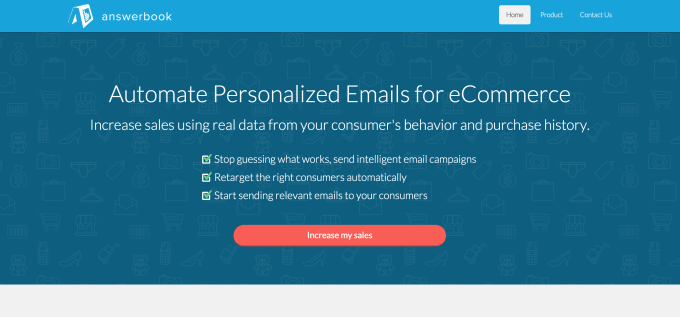
A team of e-commerce vets is today launching a new service aimed at online retailers called Answerbook which allows companies to better target shoppers with highly personalized emails based on those customers’ website and email interactions as well as their purchase history. The solution today is largely aimed at smaller retailers, like those hosting their sites on e-commerce platforms like Shopify, where they have somewhere between half a million to a million in sales.


However, the company is already talking to larger businesses in an effort to develop an enterprise tier to its service, we’re told.


Answerbook was founded last year by Chris Nguyen and Lee Liu, both of whom have backgrounds in e-commerce and using data for targeting purposes. The two had previously built and sold their recruiting site JobLoft to onTargetjobs in 2007, and then sold dating site Cupid.com to EasyDate. They also founded a social commerce site called TeamSave in 2010.


While in all their prior efforts, the founders had learned the value of leveraging data in order to attract and re-engage users, it was with TeamSave that they began building an internal personalized marketing solution, using things like website preferences, clicks and purchase history to better reach their customers.


answerbook


Explains Nguyen, smaller companies don’t have the tools to do advanced targeting the way that the bigger guys, like Amazon, eBay and Walmart do. And the solutions for email personalization that are out there today often only look at customer purchase history, not other factors.


“We started talking to e-commerce companies, and they said, ‘we have this problem – we’re sending blast emails everyday but we don’t know how to personalize this information,’” says Nguyen. The companies have internal teams who could pull data to personalize their emails, but by the time they did, it would be too late for that data to still be actionable. “Can you help us automate that?,” these businesses said.


“I love the fact that companies like Shopify allow you to make a fast and efficient online store in days, but they lack the resources to truly understand the marketing aspects,” Nguyen adds, explaining the hole in the market he hopes Answerbook can fill.


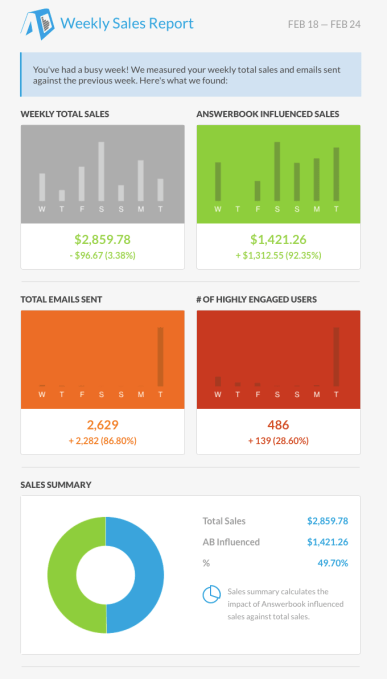
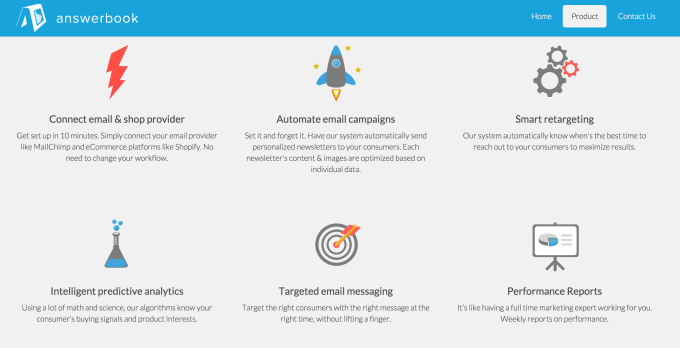
To use Answerbook, retailers place a single line of JavaScript code on their website, similar to setting up something like Google Analytics. Afterwards, they’re then able to track things like what pages and products a customer is viewing, what they’re placing in their cart, their purchase history and more. Combined with email interaction behavior, this data can then be used to create a series of personalized emails for each customer.


Screen Shot 2015-02-25 at 1.14.05 PM


Screen Shot 2015-02-25 at 1.16.17 PM


Included in Answerbook’s service are a half-dozen “triggers” a retailer can kick off, which help them to configure emails related to things like price drops, cart abandonment, items that have returned to stock, website abandonment, or they can send emails that simply recommend products or showcase what’s new and trending this week on the retailer’s site. Businesses can also choose to create their own custom triggers, or combine the ones provided to more narrowly target their customers. And Answerbook today works with other email services the company may already be using, like MailChimp, for example.


The company has been in private testing with a small handful of retailers ahead of its public launch. One online phone case company saw a 40% lift in sales after setting up Answerbook to email reminders to customers which included a 15% promotion to complete their orders. However, because of each business’s potential needs, and because of the newness of the service itself, a sales lift of that much may not be typical. Nguyen admits that the lift can range anywhere form 15% to 40%, depending on the given situation.


Answerbook is currently priced beginning at $50 per month for 500 customers analyzed and then increases in tiers that go from $150/month to $199/month, with an enterprise option in the works.


The company has also raised $700,000 in seed funding from Y Combinator, Kima Ventures, Tamares (a Palantir backer), and a group of San Francisco Bay area angels.


Longer-term, Nguyen says that Answerbook’s goal is to do more than personalize emails, but to personalize the targeted messages customers receive elsewhere, too. In the future, the service will include support for mobile commerce as well, allowing retailers to personalize their in-app push notifications and even SMS texts.


Featured Image: Shutterstock


YC-Backed Answerbook Helps Retailers Automate Personalized Email Campaigns