Green App Machine
Posts mit dem Label Customer werden angezeigt. Alle Posts anzeigen

Sprint Dials Up Conversocial for Customer Service via Facebook Messenger

SprintLogo640

Wireless giant Sprint teamed up with Conversocial, a cloud-based social customer service solution and Facebook Marketing Partner, to provide customer service via Facebook Messenger.


Conversocial said in a release that Sprint determined that a large chunk of its customer base preferred to address account- and service-related needs via social media, so the wireless carrier implemented Conversocial’s Messenger integration to serve that group.


Conversocial said it manages more than 11 million social media messages each month across social media channels including Facebook, Twitter, Google+, Instagram and YouTube.


Sprint senior vice president of customer care Marci Carris said in the release:


We want to build long-term relationships with our customers who choose to engage via social channels and have the ability to respond in the channels they want to connect with us. The addition of Messenger to our social care efforts was a simple decision. We are the first U.S. telecommunications company to implement Messenger. This channel is a way for us to have meaningful conversations with our customers when they decide and in the channel of their choosing.


Conversocial founder and CEO Joshua March added:


The conversation is taking place on mobile applications, and telecommunications businesses such as Sprint know that they need to be where the consumer is to assist—in the same channels and the same conversation—to help, engage and wow them. Facebook’s new Businesses on Messenger is going to be a growing channel to do this, and it brings in many new features including real-time chat, the ability to search for Sprint in Messenger and other innovations that will really serve social care–it’s reinventing live chat for the mobile generation, and we’re excited to be one of the partners enabling this new functionality and implementing it with a socially recognized brand such as Sprint.


Consumers don’t want to be on one platform and then told, “Please email or call us,” by the brand. They want to have the conversation where they are and resolve any problems there—brands such as Sprint recognize this in-the-moment customer service philosophy. The launch of Messenger shows how mobile customer service is maturing as a channel for the consumer to engage with a brand.


Readers: What do you think of the use of Messenger for customer service?


ConversocialMessenger


Sprint Dials Up Conversocial for Customer Service via Facebook Messenger

Internet Marketing / Customer Service

We are a 15 year old company specialized in formulating and marketing probiotic dietary supplements for digestion.


Duties include:


Social media marketing (blogging, social networks), e-mail marketing (design, develop, lists), directories and listings (paid listings, lead generation), public relations (articles, press releases), online advertising (affiliates).

Good data base development.

Answering phones, Customer Service, Getting orders


Skills Required:


Degree in Marketing /Computer Science/Business Administration.

3+ year experience in internet marketing and customer service

Good communication skills.

Background in nutrition and health is a plus.

Computer Savvy, QuickBooks knowledge is a plus.


Internet Marketing / Customer Service

How to Boost Email Marketing ROI? Put Your Customer Data to Work

Only 20 percent of marketers use behavioral triggers to accompany their email marketing strategies, according to Econsultancy. Past issues with implementation and the lack of comprehension of the outcomes email triggers can drive on behalf of the e-commerce company have led many email marketers to believe the many misconceptions about trigger emails.


With data come opportunities
The expectation of today’s marketers is to monitor the analytics of their campaigns to ensure they are providing a positive ROI as compared to their investment in a specific channel. The industry has reached an inflection point where marketers need to know how to take action on their data and understand the technologies available to help them better facilitate driving results from company data.


Referring to analytics is often the starting step to discovering value in your customer data for many marketers, whether it is through Google Analytics, Omniture, or an alternative tracking platform, and to begin getting into the performance of your various conversion funnels. Larger organizations may have business teams devoted to analyzing and segmenting this data.


A frequently overlooked source of vital data can be taken directly from your product catalogs. Both customer behaviors and changes to the product catalog will show trends around failed conversions, customer drop-off points or out-of-stock products. These are potential opportunities to reengage with your shoppers and help influence them to convert with automated emails.


For example, many e-commerce companies find data that suggests their shoppers start an order but do not complete their purchase. This shopping cart abandonment data can demonstrate a great amount of lost opportunity revenue. With some companies reporting that up to 74 percent of shopping carts are left abandoned, it is not an uncommon problem.


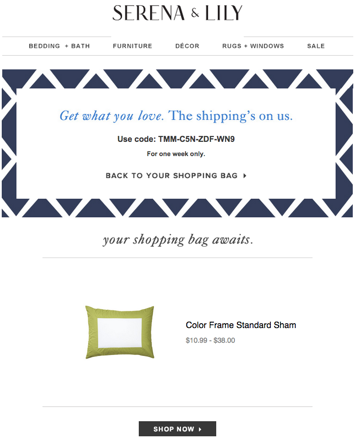
Through analyzing your conversion funnels and customer data, you can better distinguish where behavioral triggers can help to drive ROI. For example, Serena & Lily aimed to tackle lost opportunities that they found in their data by triggering the following email when a shopper abandons her order.


Description: erena & Lily seeks to drive revenue by targeting shoppers who failed to complete their transaction.


Serena & Lily attempts to increase revenue through targeting shoppers who failed to complete their transaction.


In addition to a reminder, Serena & Lily also offers free shipping to better incentivize their shoppers to return and make a specific purchase. While offering incentives can improve the effectiveness of a specific triggered email, it is recommended you test a variety of these tactics to determine which fit best with your marketing and revenue goals.


Triggered email implementation = increased ROI
While improving metrics for open, click through, and conversion rates for automated emails is important, perhaps what is most notable is that automated emails generated nearly three times more revenue than their manually delivered counterparts.


Automated emails are often more effective because your brand can target your audience based on their behavioral data, meaning that you can send more relevant and personalized content to your shoppers while your company is already top of mind.


For example, let’s say a shopper recently purchased a pair of Herringbone suit pants from Perry Ellis. By sending an automated follow-up email, Perry Ellis now possesses the opportunity to upsell and create more revenue by catering this email content to the details that the shopper provided at checkout.


Description: erry Ellis appeals to their shopper⤙s interests by promoting related products with partial discounts.


Perry Ellis appeals to its shoppers’ interests by promoting related products with partial discounts.


The retailer also takes advantage of customer data to better comprehend what products are related or frequently purchased together and can use this to provide more interesting content to its shoppers. The more personalized the email, the more likely it will resonate with the shopper and create positive actions.


It’s also vital to understand the difference between trigger emails that drive engagement and immediate revenue for your business. For example, many post purchase emails are typically more focused on engagement, satisfaction and driving revenue in the long-term like a survey or content centered around better using a product recently purchased, than they are on generating immediate revenue from an existing customer like a related products trigger.


The difference in whether a trigger drives action or revenue is completely dependent on the company, the typical product order value, and the objective they are trying to achieve. Triggers are flexible when you have a system that allows you to rapidly adjust dependent on the feedback you’re receiving from your customer and product catalog data.


To best drive revenue for you company, prioritize the customer behaviors that are stopping conversions and develop personalized triggered emails that help escort your shoppers through your sales funnels. Evaluate the interests and needs of your shoppers when designing these emails to better increase opens, click through rates and the ROI of your email marketing campaigns.


Ryan Luckin is head of marketing and communications for Bluecore, a marketing automation solutions provider.


How to Boost Email Marketing ROI? Put Your Customer Data to Work

Vize Capital Acquisition Of Bevo Media Promises Exciting Upgrades And Customer Support ...


Following the acquisition, Bevo Media foresees increased opportunity to expand affiliate marketing and performance marketing offerings for customers.


SAN DIEGO, CA, USA, September 14, 2015 /EINPresswire.com/ — Bevo Media (http://www.bevomedia.com/), a popular tracking platform and ad exchange in the performance marketing industry, has been acquired by Silicon Valley-based private equity firm Vize Capital (http://www.vizecapital.com). Vize Capital plans to invest significant resources into growing and further improving the platform.


Bevo Media’s founder and CEO Ryan Bukevicz states, “This is a huge milestone for the Bevo team and our customers. Through this acquisition, Bevo Media will have the infrastructure to better provide for our thousands of advertisers and tens of thousands of tracker users. This milestone will help us to fulfill our ultimate vision of Bevo Media and take our company to the next level.” Bukevicz plans on staying active within the company post-acquisition.


Launched in 2010, Bevo Media was one of the first third party click-tracking platforms made specifically for performance marketers. In 2013, Bevo Media launched the Bevo Ad Exchange, which features a streamlined affiliate channel where advertisers can bid on affiliates as traffic sources.


Vize Capital (VC), headquartered in the heart of Silicon Valley, is a global investment firm with several million dollars in assets under its management. VC manages assets through a variety of investment funds, focusing exclusively on Internet businesses worldwide.


“Over the last several years, BevoMedia.com has proven itself to be a leader in the performance marketing space. Bevo’s technology remains ahead of the competition. With this acquisition, thousands of Bevo users can expect to see additional capabilities added to the platform,” says Atif Kazmi, Vize Capital CEO.


VC seeks to create value by bringing operational expertise to its portfolio companies through active oversight and monitoring of its investments. VC complements its investment expertise with strong investor relationships.


“Bevo’s technology will also serve as an add-on to another Vize Capital company, Vizdum (http://www.vizdum.com/). Together, both Bevo and Vizdum will act as a robust online marketing technology suite,” added Kazmi.


About Bevo Media:
Launched in 2010, Bevo Media began with their Affiliate Portal, which serves as a one-stop-shop for affiliate marketers to not only manage and track their campaigns, but also provides optimization tools, keyword/ad tracking, and split testing. In 2013, Bevo Media expanded its offerings to include Ad Exchange, an innovative platform that allows advertisers to bid on affiliate traffic via CPA or CPC. A cornerstone in the performance marketing industry, Bevo Media was acquired in August of 2015 by Vize Capital.


Media Contact:
Ryan Bukevicz
Bevo Media
ryan@bevomedia.com
11622 El Camino Real Suite 100
San Diego, CA 92130
1-888-644-2386


Atif Kazmi
Vize Capital
5201 Great America Pkwy., Suite 320,
Santa Clara, California, 95054
atif@vizecapital.com


Press release courtesy of Online PR Media: http://bit.ly/1UQ3eVO


Atif Kazmi
Vize Capital
.
email us here


Vize Capital Acquisition Of Bevo Media Promises Exciting Upgrades And Customer Support ...

3 steps to better customer personalization

The fact that personalization is a hot buzzword among email marketers today should come as no surprise. Consumers appreciate when companies deliver relevant messaging directly to their inbox. Personalized emails allow marketers to create highly tailored messaging at the individual customer level, making customers feel appreciated and loved. Even more importantly, personalization helps drive customers to take a next step. This level of intimacy goes well beyond simply including the customer’s first name in the greeting. Using data, marketers can create one-to-one messages that reflect the customer’s preferences and drive ROI.


If you aren’t sending personalized emails, then you need to start. Radicati estimates that 196.4 billion will be sent this year. The only way to get noticed in the increasingly hectic inbox is to send messages that resonate directly with the customer. Establishing a personalization stream in your email marketing program should not feel overwhelming. Create a plan to build personalization for your brand in phases, which will be dependent upon the maturity level of your current email program.


Phase 1: Basic personalization


To launch a personalized email marketing program, we encourage you to simply start with the basics. Basic personalization involves creating messages that are targeted based on information that your customer provided to you upon registration. This could include information such as gender, location, or birthday. Using this contextual data can help create a personal experience in email.


For instance, if your customer is based in New York and you know that a snowstorm is about to hit the area, then you can build a campaign around the information that you know. Retail companies can use this opportunity to push their snow gear, while a travel marketer might capitalize on the need for some sun to escape the cold winter. A ski resort, on the other hand, might promote its fresh show and nearby location. A restaurant may email a coupon to people wanting to order dinner in. Depending on your business and what you sell, you can take advantage of real life current events to personalize emails.


Phase 2: The preference center


The next phase of personalization in email is the intermediate level. In this phase, you should be looking at deeper demographic information that you have collected about your customer, which is usually accomplished via a preference center. Customers that have filled out a preference center have raised their hand to identify the types of emails that they want to receive. Customers share these details to express interest, and it is your job to ensure that your email content matches their preferences. Do they like all of your emails or just a certain type? A retail customer may only be interested in hearing about a store’s shoes as opposed to all of its products. A publisher’s customer might only want email updates about weather and don’t want their inbox cluttered with anything on sports, entertainment, or breaking news. Tailor each customer’s email to his or her individual preferences to build a lasting relationship with your customer.


Phase 3: Customer behavior


The third phase of personalization in email is to target emails based on a customer’s behavior. Site browsing, past purchases, and loyalty activity can tell a marketer a lot about the customer, and it’s your job to make this data actionable. Look at how customers are responding to your emails, how they are browsing your site, how they are interacting with their shopping carts, and what they have previously purchased to personalize future mailings. Adapting these data points into your email program is the key to creating a highly tailored and personalized email experience.


Personalization is no longer a nice-to-have aspect of email marketing — it is a must-have. Implementing a personalization program is not as hard as you think. Consumers are constantly telling you things about themselves, you just have to figure out how to implement that data and make it actionable to create targeted, personalized messages. Personalization shouldn’t just be a buzzword; it should be a best practice of every savvy email marketer.


Tony D’Anna is CEO at PostUp


On Twitter? Follow iMedia at @iMediaTweet.


3 steps to better customer personalization

When Don Draper Died, Customer Service Became The New Marketing

[unable to retrieve full-text content]


Customer service, in other words, is the new marketing. … because they can look to their Facebook friends to find out the truth, you’d better make sure …


When Don Draper Died, Customer Service Became The New Marketing

When Don Draper Died, Customer Service Became The New Marketing

Though all signs indicated that Don Draper was going to drown himself off Big Sur in the final episode of Mad Men, he ended up surviving the series and buying the world a Coke.  Yet in real life, Don Draper is as close to dead and gone in the world of business as he possibly could be.


And it wasn’t the Lucky Strikes that did him in.  It was the new power of customer word of mouth, and the increased importance of the customer experience.


Customer service, in other words, is the new marketing.  And it’s even more powerful than the old kind.


Here’s what I mean: Once upon a time, you could guarantee success for your product or service if you just slathered on the mass-marketing real thick. You could hire a real-life version of Don Draper or Peggy Olson and have them add that that coating of marketing magic to the product or service you wanted to sell.


It didn’t matter so much if your washing machines were or weren’t reliable; what mattered was that the marketers working for you had dazzled the buying public with a brilliant mascot like the lonely Maytag repairman, making sure that your appliances seemed reliable.


It didn’t matter if your product was Coke and had a lot more to do with cavities than with world peace, suddenly in these genius’s hands, buying a coke was magically made to relate to creating “perfect harmony” worldwide.


With such marketing genius at your disposal, and a purchasing public that still believed that there was truth behind these kinds of mass marketing messages (“if it wasn’t true, they wouldn’t let them say that, right?”) your product would sell.  Your work would be done. Your business would be on its road to success.


Jon Hamm as Don Draper, from the final season of “Mad Men.” (Justina Mintz/AMC via AP)


The world has changed.


Over time, however, the business landscape became more challenging. It came up against consumer cynicism, and it came up against enhanced  word of mouth made possible through cheaper and faster communication methods (including such now-forgotten factors as the reduced cost of air travel and even the move from expensive to essentially-free long distance calls).


And, of course, the biggest chinks in the armor of marketing-driven products and services have come via the Internet, especially the websites and social media outlets powered by user-generated commentary.


Customer Service Is The New Marketing


Businesses are agitated about this changed landscape, and rightly so. This new, transparent marketplace is a scary place in which to do business. But it’s where all of us have to do business today. The balance of power has changed, with that power now weighted toward the customer in a big way.


Don Draper’s obsolete world of the “4-P’s” (product, place, price and promotion) has now been replaced by the dominance of human interactions, customer-on-customer and employee-on-customer, the “big H” as I call it, for human beings.  Today, all customers care about is how their fellow humans, online and off, have been treated by the humans who work for your company. This is the reality of our new, customer-driven world.  


And we all need to adapt: When customers no longer care what some actor on TV–the Maytag repairman, for example–says about your product, because they can look to their Facebook friends to find out the truth, you’d better make sure those Facebook friends are, in fact, inspired to say something nice about you–about how you responded to their service inquiries and product concerns. Inspired, that is, by how you treat them as customers.


There’s no better way to grow your brand, customer by customer by customer, than by getting this right.


Micah Solomon is a customer service consultant, customer service speaker and bestselling business author, most recently of High-Tech, High-Touch Customer Service


When Don Draper Died, Customer Service Became The New Marketing

Custora Raises $6.5MM Series A to Integrate Predictive Customer Insights into the Marketing Cloud


        Print


| Source: Custora

NEW YORK, April 7, 2015 (GLOBE NEWSWIRE) — via PRWEB – Custora, a marketing software startup based in NYC, announced today the close of a $6.5MM Series A led by Foundation Capital with participation from Greycroft Partners and Valhalla Partners. The new funding will enable Custora to scale out sales and marketing and more rapidly develop the company’s B2C marketing software platform. Custora, a Y Combinator company, raised its seed round in 2011 and has been growing based on customer revenue over the past few years.


Custora provides a predictive marketing platform built for e-commerce teams. Its software analyzes data to predict how customers will behave in the future – the things they’re likely to buy, how much they’ll spend, even how often they’ll shop. These customer-specific insights enable brands to advertise and communicate in more effective and meaningful ways.


“It’s a new type of software – part predictive analytics, part B2C marketing automation,” says Corey Pierson, Co-Founder and CEO of Custora. “The goal is for marketers to spend more time thinking about how to treat their customer segments at different points in the buying cycle, and less time caught up in data analysis and list management.”


Customer data is spread across so many silos that it is a real challenge for marketers to surface meaningful insights about their customer or implement marketing campaigns that leverage those insights to drive more sales. To respond to that issue, Custora has built the first platform that aggregates data from the whole ecosystem, leverages predictive analytics to surface customer insights, then integrates those insights back into existing marketing tools – making it easier for marketers to utilize those insights in daily campaigns.


For example, Custora monitors in-store and online purchase data along with website and email engagement data and identifies specific customers who seem to be veering off their usual purchase tendencies. Then, the platform integrates with existing email marketing software to automatically trigger the appropriate “win back” email at the appropriate time.


“Custora has surfaced deep, actionable insights about various customer segments,” says Jason Wang, Senior Director of Strategic Planning and Operations at Guess?, Inc. “We have a much better grasp of our different shopper types and of our omnichannel customers – and when we’re tailoring campaigns based on those insights, it’s driving real lift.”


“It doesn’t make sense for insights and actions to be disconnected. Dashboards don’t drive revenue for marketers,” says Anamitra Banerji, partner at Foundation Capital and newest addition to Custora’s board. “Shoppers are demanding smarter, more relevant marketing campaigns. What makes sense is for software to help marketers bridge this gap.”


Though the company has yet to invest heavily in sales and marketing, they have attracted an impressive roster of customers including Ann Taylor, Guess, Reebok, Bonobos, and more. “Retailers are finding us by word of mouth because they hear our product simply works. ROI sells,” Pierson says.


About Custora


Custora provides the leading predictive marketing platform for e-commerce teams. It helps retailers acquire valuable customers and improve customer retention. The software analyzes data to predict how customers will behave in future — the things they’re likely to buy, how much they’ll spend, even how often they’ll shop. The software then integrates with existing marketing tools so marketing teams can leverage customer-specific insights to advertise and communicate in more effective and meaningful ways. Custora is proud to work with a variety of online and omnichannel retailers including LOFT, Guess?, Crocs, Bonobos, and Backcountry. Based in Manhattan, NYC, Custora is a Y Combinator company, and is backed by prominent venture capital firms and angel investors. To learn more, visit http://www.custora.com/


About Foundation Capital


Foundation Capital is dedicated to the proposition that one entrepreneur’s idea, with the right support, can become a business that changes the world. Foundation Capital has helped companies like Lending Club change the way money is lent and borrowed and Netflix revolutionize media distribution and consumption, among many others. Foundation Capital is currently invested in more than 60 high-growth ventures in the areas of consumer, information technology, software, semiconductors, and clean technology including Beepi, BoardVantage, Chegg, Coverity, DogVacay, Kik, ForgeRock, Lending Home, Simply Hired, Spoon-Rocket, Sunrun, and Venafi. Foundation Capital’s twenty-five IPOs include Lending Club, OnDeck, MobileIron, Control4, TubeMogul, Envestnet, Financial Engines, Netflix, NetZero, Responsys and Silver Spring Networks. For more information, visit foundationcapital.com.


This article was originally distributed on PRWeb. For the original version including any supplementary images or video, visit http://www.prweb.com/releases/2015/04/prweb12634817.htm


Custora
elizabeth conway

+1 2128931208


Custora Raises $6.5MM Series A to Integrate Predictive Customer Insights into the Marketing Cloud