check out For More Information
Social Media: How you can dominate Twitter, Facebook, Instagram and Youtube and make passive income

check out For More Information
Ever tried talking about your work to someone you just met at a big, crowded party somewhere? More often than not, you’ll have to repeat yourself two or three times, while the other person squints and leans in, trying to hear you over the noise that only a throng of 100-plus people in an enclosed space can produce. Sooner or later, your conversation buddy changes the subject or wanders away in search of more drinks.
Now multiply the noise several thousand times, and that’s you trying to talk about your work to the internet. Only the people you’re trying to reach are already constantly bombarded with unrelenting volleys of information. So how do you get through?
Singapore-based Ematic thinks it has a solution for your voice to rise above the din. The three-year-old startup provides applications and insights on email marketing, specializing in ecommerce. Its products are aimed at marketers who want to increase their company’s visibility and attract more customers, by streamlining their marketing methods.

Paul Tenney, Ematic founder and CEO
“The way I look at marketing technology, it’s between campaign and channel,” Paul Tenney, founder and CEO of Ematic, tells Tech in Asia, talking about the methods available to marketers for reaching their intended customers. “There are tools that are great for campaigns and tools that are great for managing channels, and there have been attempts to do both with the same product. I don’t think that works very well.”
Paul founded Ematic in 2012, after coming to Singapore as the Asia-Pacific person for Silicon Valley email marketing firm Yesmail. The Stanford graduate had previously been a director for the company’s California-based business, working with clients like Hewlett-Packard, Macy’s, and eBay.
Once in Asia, Paul noticed that existing digital marketing solutions for local companies couldn’t work the same way as in the US; they were expensive and complicated, and took too long to implement. Paul wanted to start his own company to provide a better way to Asian businesses. Being in this space since 2004, he had considerable experience to bring to the table, as well as the help and expertise of a lot of his former colleagues. And so Ematic was born.
Ematic’s solution is a set of software tools that can plug into a company’s chosen campaign management method or its website. For example, a company may be using Mailchimp for its marketing needs. Ematic’s tools connect to it and provide recommendations and actions based on machine learning and artificial intelligence.
There are currently two apps made by Ematic that tackle different sides of its mission.
HiIQ is a tool that suggests when is best to say hi, and to whom. The system works with the user’s database to determine when to fire off emails and to which addresses, targeting (hopefully) the right people with the right message. This results in less time and energy wasted by the marketer, and less noise for the people the message is trying to reach.
ByeIQ is a piece of software that determines what messages and calls to action to display to a user about to leave your website, and when. The idea is to get the user to either subscribe to the website’s mailing list or to become a customer and make a purchase. Paul says this is done in a way that’s seamless and does not interrupt the user’s experience.
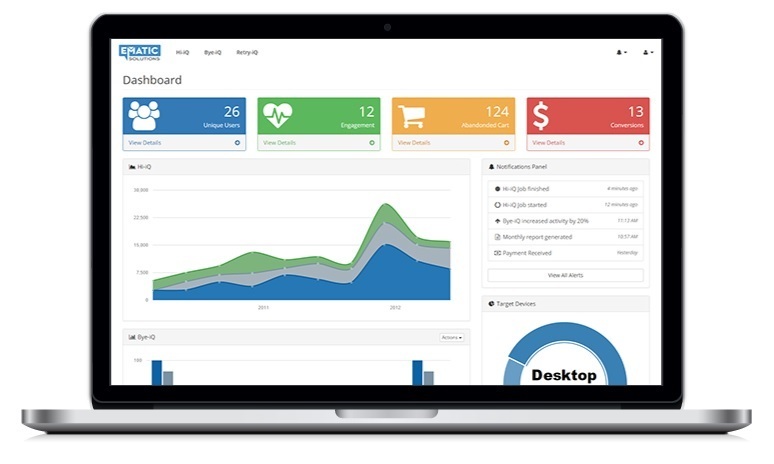
Image credit: Ematic Solutions
“We basically boil down email marketing to a three-metric approach,” Paul explains. “How many new subscribers you can add to your database, how much engagement you are able to drive, and how many conversions you are able to drive.”
Ematic announced today it has raised S$1.5 million (US$1.07 million) in a seed round led by venture capital firm Wavemaker Partners. 500 Startups and Convergence Ventures also joined in. The startup says it’s continuing to seek additional investment in this round.
Most of the funding will be put toward product development, Paul explains. The rest will be used for “strategic growth” within Southeast Asia. Other markets will follow later through subsequent funding rounds, as Ematic aims for more territories around the world.
Paul is pretty happy with these particular investors. Wavemaker has the desired expertise on how to help a business-to-business-focused company like Ematic, he explains. As for 500 Startups and Convergence, he finds there is a strong culture fit with the startup, while the latter offers a valuable local contact when it comes to partnerships within Indonesia.
The startup won’t disclose numbers, but Paul says it is ahead of its targets in terms of revenue at the moment. It has cleared the 50-customer mark throughout Southeast Asia, including Singapore, Thailand, and Indonesia, boasting clients like cosmetics ecommerce website Luxola.
Editing by J.T. Quigley and Terence Lee
When I say “marketing,” what is the first thing that pops into your head? Quirky TV ads? Flash mobs? Or big brand names sniping at each other on Twitter? Whatever you think of, there’s no doubt that marketing is a constantly-changing field, and in fact marketing as we know it is the result of years of responding to changing consumer needs and new technologies. To help celebrate the AMA’s Marketing Week, let’s take a look back at how marketing has evolved over the years.
Outbound Marketing
When most people think of marketing, they think of traditional, or outbound, marketing: TV commercials, radio ads, billboards, telemarketers, direct mail, the works. If someone is talking at you trying to convince you to buy something, that’s outbound marketing.
This traditional form of marketing goes back all the way to the 1700s, when magazines first emerged as a medium. By 1839 posters were became such a popular method of advertising that they were banned on properties in London, while the first recorded billboard rental took place in 1867. If there is one overarching thread in the history of marketing, it is that marketing and new technologies go hand in hand. Since its invention in 1922, radio has been used by marketers to broadcast advertisements over the airwaves. As for TV, the first ad aired in 1941 and by 1954 TV advertising was bringing in more money than magazine and radio. By the 1970s, magazines and other print media increasingly felt the competition of new technologies as TV continued to grow and telemarketing became a common marketing tactic.
When computers took the stage in the 1980s, marketers kept right up and harnessed the ease of desktop publishing to create a boom in print advertising. And of course, with the rise of the internet came the use of email marketing (and its dark side: spam). 1995-97 saw the baby steps of search marketing and search engine optimization (SEO) on platforms like Yahoo, AltaVista, and Ask.com. MSN and Google soon followed, with Google introducing its own search algorithm, Adwords in 2000, and Google Analytics in 2005.
All this new tech was huge for marketing, but it also exposed problems with the traditional method of pushing information out to the public. Email marketing was being abused as spam, telemarketing was getting pushback in the form of the Do Not Call list… The main problem with outbound marketing was clear: consumers just don’t like having products pushed on them. Which is why inbound marketing is becoming the new norm for marketing.
Inbound Marketing
The new millennium brought with it the explosion of blogging, and with it the beginnings of content marketing. Instead of talking at consumers, bloggers talked to them and provided content that was actually useful, thereby attracting more like-minded people. And so inbound marketing was born!
Inbound marketing differs from the traditional method in that it tries to engage and attract customers to a company’s product by sharing valuable information and ideas. The goal is to connect with the audience and build a relationship that benefits both sides.
Fortunately, it was around this time that getting connected got a lot easier. Social networks came on to the scene in 2003 with LinkedIn and MySpace, soon followed by Facebook in 2004 and Twitter in 2006. Google+ tagged on in 2011. E-commerce sales also skyrocketed: in 3 years Amazon’s sales jumped from $10 billion to $25 billion in 2009.
The trend is clear: consumers want to interact with brands, not just absorb their messages. By 2011, young people spent more time on the internet than watching TV. And with smartphones increasingly dominating the scene, people can stay connected wherever they go.
Marketing’s response to these new technologies spreading like wildfire? The development of relationship marketing, internal marketing, socially responsive marketing, guerrilla marketing, digital marketing, viral marketing… the list goes on. The internet and social media lets companies connect with consumers in ways that would be unimaginable in years past. And with big data analytics becoming increasingly important and new technologies evolving every day, marketing will likely look very different in the coming years. But as long as there has been media, there has been marketing, and it will be exciting to see what the future holds!